

How do bacteria make proteins?
DNA sequence

In bacteria the DNA is on a circular chromosome. It is a double stranded helix.
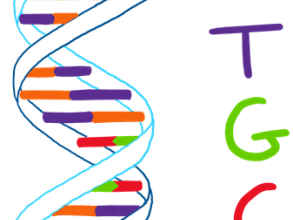
On Zooniverse, we look at one strand of DNA, the one that encodes the gene of interest. The other strand is "complimentary" to it and pairs it.
A (orange) pairs with T (purple) and C (red) pairs with G (green).
This is complimentary base pairing and is a very important feature of DNA.
It enables DNA to be transcribed (below) and replicated.

mRNA Sequence
mRNA is single stranded. It has Us instead of Ts.


Protein

Proteins are made of amino acids. The ribosome reads mRNA to get the sequence.
Proteins have lots of different roles:
Some are ENZYMES, for example ones that break down food - we have these!
Another human example is haemoglobin. This protein is found in a blood cells and is responsible for carrying oxygen.